

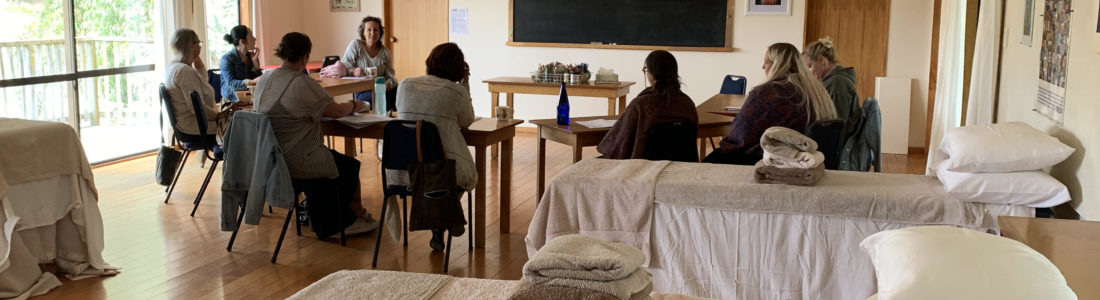

Taruna College, with the endorsement of the Anthroposophic Nurses Association in Aotearoa NewZealand, offers the Foundation Course in Anthroposophic Nursing (FCAN). This part-time programme will offer an orientation and pathway for those nurses looking to further develop their work in a more holistic way. The Course broadens the understanding of the human being to include the spiritual, biographical, soul, vital and physical aspects for both the nurse and those being cared for.
Clinical practice includes competence with a range of external applications including Rhythmical Einreibung (RE), a specialised nursing therapy working with rhythm, warmth, gentle massage and intention.
The programme has international accreditation from the International Forum for Anthroposophic Nursing representing the Medical Section of the School of Spiritual Science, Goetheanum, Dornach (Switzerland).
NB: Course certification requires successful completion of all requirements including full participation, self-study and assessment events.
There are currently 13 IFAN-accredited Anthroposophic Nurse Specialists in New Zealand, and we intend to offer further coursework to prepare certified anthroposophic nurses to apply for ANS accreditation in the future.
We are currently in the process of completing study requirements with participants from the 2024 FCAN programme and are inviting expressions of interest from nurses for a March 2027 intake (Dates TBC).
The programme spreads a little over two years and includes four compulsory five-day seminars onsite at Taruna with home study, online contact and clinical practice following each seminar. Seminar dates in 2027 and 2028 will probably be scheduled in March and October/November with due dates for final assignment completion in April 2029.
PLEASE NOTE: Minimum numbers are necessary for the course to go ahead. Please ensure any flights booked are fully refundable in case of any unforseen circumstances.
Course Fees
Programme fee is $5000*. The course must be paid in full by the start date of the course. Payment can be made in installments by either applying for a loan through Crystal Bridge or paying equal instalments from the date of enrolment until the start of the course, the amount may vary depending on the date of enrolment and Seminar One start.
Course Co-ordinators
Deborah Bednarek RN MN and Michelle Vette RN MN
Anthroposophic Nurse Specialists and Rhythmical Einreibung Specialists (IFAN)
Nursing Pathways
You can read about the pathway of three registered nurses, who became anthroposophical nurses through the course at Taruna. This short article gives an idea of how the nurses integrated anthroposophic nursing into their professional practice. You can read about them here: Anthroposophic Nursing Pathways
Venue
Taruna College, 33 Te Mata Peak Road, Havelock North, Hawkes Bay.
Student Support
Taruna aims to ensure that the programmes delivered are beneficial to each and every student. Support is available to all students via the Course Coordinators whilst on-site and in between seminars to ensure that progress is achievable.
Crystal Bridge was founded in 1991 as an initiative to help students at Taruna College with their course fees, at a time when there was no possibility of government-sponsored student loans. The fund is open to all New Zealanders wishing to undertake study, locally or internationally, based on the work of Rudolf Steiner. Loans are interest-free and tailored to the individual borrower, but are usually repaid over 1-2 years. There is also a fund or gift money, the prerequisite for such a gift being that it benefits a group of people. Donations to the fund are gratefully received.
The Crystal Bridge loan fund makes interest free loans available to students enrolled in Signature Courses at Taruna.
Anthroposophic Nursing – an introduction
(Adaption of a translated article by Rolf Heine the Coordinator of the International Forum for Anthroposophic Nursing in Anthroposophische Pflegepraxis. Grundlagen und Anregungen für alltägliches Handeln. 3rd ed. Berlin: Salumed; 2015.)
Extensive concepts for nursing practice, training and research based on Rudolf Steiner’s approach to knowledge have been developed within the anthroposophic nursing movement since 1923. The aim of anthroposophic nursing is to assist people to find their individual way – on the level of body, soul and spirit – during phases of life when they are ill and dependant on care. Nurses in collaboration with doctors and therapists have been contributing to the realisation of a spiritual art of healing.
Anthroposophic nursing understands the human being to be a free, evolving being that has manifold connections to self, nature, culture and the cosmos on the various levels of body, soul and spirit. Nursing serves to maintain, or where necessary, regain or redevelop these connections. Each human being is the measure of these evolving interactions. Each biography, illness or social relationship has its own patterns and rhythms, that seldom progress in a linear fashion. Research and understanding of these connections and their significance for human freedom form the basis for developing concepts for nursing, training and research. Anthroposophic nursing is not founded on a closed, normative, theoretical system. Rather, it can arise wherever nurses rely on an anthroposophic background understanding from which to provide professional care out of knowledge and love, with presence of mind.
Knowledge and love, as well as all other traditional virtues and values of the nursing profession, are not morally normative imperatives. They are developmental opportunities within each nurse or therapist, who is responsible for her or his own conscience. The nurse, like the patient or client, is a human being in a process of development, whether professionally or personally. Self-chosen professional progress or regression can be seen not just in terms of outer skills and competence. Professional progress is also found in the readiness to cultivate emotional and spiritual qualities such as love and compassion. Spiritual nursing care will concern itself with questions of reincarnation and karma, as well as with questions about the spiritual and social significance of the various work specialities, such as that of perinatal care or the care of patients who are in a vegetative state. It is only against such a background that ethical questions become objectively discussable, outside the constraints of a normative code of practice.